
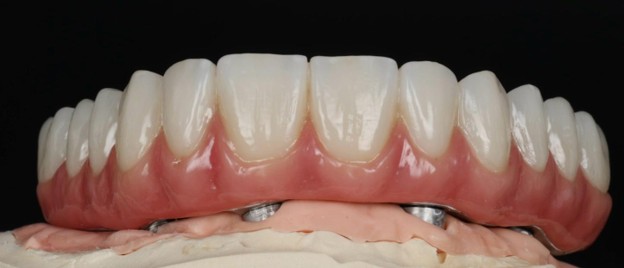
All-on-X has become one of the most clinically significant full-arch rehabilitation protocols in modern implant dentistry. For dentists offering this treatment, the quality of the prosthetic outcome depends heavily on the laboratory partner behind it. Smile Art Lab works exclusively with dental professionals to deliver digitally designed and manufactured prosthetics through a structured 3D digital workflow.
Key Takeaways
- All-on-X uses four or more implants to support a fixed full-arch prosthesis.
- 3D CBCT scanning and digital planning are essential for predictable outcomes.
- Smile Art Lab works only with dental professionals, never directly with patients.
- Prosthesis material choice directly affects long-term durability and aesthetics.
- Laboratory collaboration is critical from the planning stage, not just fabrication.
Understanding the All-on-X Concept
All-on-X is a general term for a fixed full-arch prosthesis supported by multiple implants. The number and distribution of implants vary according to the patient’s anatomy, restorative plan and the treating clinician’s assessment.
The familiar arrangement of two anterior axial implants and two tilted posterior implants specifically describes an All-on-4 configuration. Other All-on-X cases may use five, six or more implants, with implant positions determined through prosthetically driven surgery planning.
How Does It Differ from Traditional Implant Approaches?
Full-arch treatment can be completed using different implant numbers and distributions. In selected cases, tilted posterior implants may help avoid anatomical structures and reduce the need for grafting, but this depends on the patient’s anatomy and the approved surgical plan.
- Using fewer implants to reduce surgical burden and recovery time.
- Angling posterior fixtures to engage denser basal bone.
- Enabling immediate loading in suitable cases.
Systematic reviews have found no clear difference in implant survival between tilted and axial implants when cases are appropriately planned and restored. However, outcomes still depend on patient selection, surgical execution, prosthetic design and maintenance.
Why 3D Planning Is Essential for All-on-X Cases
All-on-X cases are prosthetically driven. The prosthetic target should be established before implant placement so the implant plan supports the intended restorative outcome.
The 3D planning workflow for All-on-X typically includes:
- CBCT Scan: Provides three-dimensional information about bone volume, anatomical boundaries and the position of relevant structures. CBCT grey values should not be presented as a precise measurement of bone density.
- Intraoral Digital Scan: Records existing dentition or edentulous ridges, occlusal relationships, and soft tissue contours in three dimensions.
- 3D Digital Wax-Up: The laboratory designs the ideal prosthesis in the digital environment, establishing tooth position, smile line, occlusal plane, and lip support before a single implant is placed.
- Guided Surgery Where Required: When guided surgery is selected, the approved implant and prosthetic plan can be used to produce a surgical guide. Guided surgery is an option rather than a requirement for every All-on-X case.
This prosthetically driven planning approach is validated in the clinical literature. In All-on-X treatment, the treatment plan is responsible for the design, number, and position of implants. Increasing the anterioposterior spread of implants and maximising implant number in biomechanically compromised bone are identified as key strategies for reducing crestal bone strain and improving long-term outcomes.
Prosthetic Material Options: What Dentists Need to Know
The prosthetic material is one of the most consequential decisions in an All-on-X case. It directly affects the durability, aesthetics, and maintenance requirements of the final restoration. Smile Art Lab fabricates both provisional and definitive All-on-X prosthetics, and material selection is always discussed with the referring dentist before fabrication begins.
Smile Art Lab’s immediate and definitive prosthetic options include:
The immediate All-on-X temporary is produced in Rodin Titan, cured in the Otoflash under nitrogen and finished with pink composite where required.
For definitive restorations, Smile Art Lab offers:
- A titanium frame with zirconia sleeves.
- An ICE Plus zirconia framework.
- A titanium bar with an acrylic wrap-around, preferably using Candulor composite teeth and high-impact acrylic.
G-CAM and Zantex can also be considered where an alternative material is preferred.
The Laboratory’s Role: Why Early Collaboration Changes Outcomes
All clinical coordination runs through the referring dentist. That distinction matters in All-on-X cases because the laboratory’s involvement must begin at the treatment planning stage, not at fabrication.
The laboratory supports the dentist across the following stages:
- Pre-Surgical Design: Smile Art Lab develops the proposed prosthetic design and generally sends it to the dentist for approval approximately five days before surgery.
- Implant-Position Capture: On the day of surgery, the implant positions are captured using the clinician’s chosen photogrammetry workflow.
- Immediate Conversion: The approved pre-surgical design is converted into the immediate Rodin Titan restoration using the captured implant positions.
- Definitive Restoration: After healing and clinical validation, updated implant-position, tissue and occlusal records are used to produce the selected definitive restoration.
The same 3D digital workflow that drives predictable aesthetic outcomes also applies directly to All-on-X cases, where precision in design transfer from the laboratory to the surgical environment is even more critical.
Clinical Considerations for Dentists Offering All-on-X
All-on-X is not a treatment that should be offered without appropriate training, infrastructure, and laboratory support. For dentists building or refining their full-arch implant practice, these are the key clinical and workflow considerations:
- Patient Selection: Candidates must have sufficient bone volume or be suitable for grafting, manageable systemic health, and realistic aesthetic and functional expectations. CBCT assessment is essential before any treatment commitment is made.
- Implant System Selection: Work with implant systems that have extensive clinical documentation and that your laboratory partner is experienced in fabricating prosthetics for.
- Immediate Versus Delayed Loading: Immediate function on the day of surgery is clinically appropriate for some patients. For others, a delayed loading protocol with a well-fitted interim bridge provides a safer path to osseointegration.
- Long-Term Maintenance Planning: All-on-X prosthetics require regular professional review and maintenance. The bridge design must allow access for cleaning, and patients must be educated on interdental hygiene from the outset.
- Multidisciplinary Coordination: Complex cases may require collaboration with periodontists, oral surgeons, or orthodontists. The laboratory’s 3D planning documents support clear communication across the clinical team.
Why the Lab Partner Matters in All-on-X Cases
All-on-X is not a case type where any lab can deliver consistent results. The complexity of full-arch rehabilitation demands a lab partner that is deeply involved from planning through to final delivery. A lab that simply fabricates from impressions is not equipped for this work.
Outcomes in implant dentistry are directly tied to the quality of the restorative team, which includes the laboratory. At Smile Art Lab, we operate as a true clinical partner, not just a fabrication service.
Conclusion
All-on-X can deliver successful functional and aesthetic outcomes when the clinical and laboratory workflows are aligned from the beginning. As your dental laboratory partner, Smile Art Lab brings precision 3D planning, material expertise, and reliable fabrication to every full-arch case you send us. Contact us today to discuss your next All-on-X case.
FAQs:
What is the difference between All-on-4 and All-on-X?
All-on-4 uses exactly four implants. All-on-X is a broader term for four or more implants, allowing flexibility based on clinical assessment.
Do All-on-X cases require bone grafting?
Not always. In selected cases, angled posterior implants may help avoid deficient bone and reduce the need for grafting, depending on the patient’s anatomy and surgical plan.
What records does a dentist need to provide for an All-on-X lab case?
A 3D CBCT scan, intraoral digital scan, occlusal records, and clinical photographs are the minimum records required for accurate 3D prosthetic planning.
What prosthetic materials does Smile Art Lab fabricate for All-on-X?
Smile Art Lab produces Rodin Titan immediate temporaries and offers several definitive constructions, including titanium frames with zirconia sleeves, ICE Plus zirconia frameworks, and titanium bars with acrylic wrap-around restorations.
When should the laboratory be involved in an All-on-X case?
At the planning stage, before surgery. The laboratory must first design the prosthesis so that the planned prosthetic outcome drives implant positions.
Can an All-on-X be loaded immediately on the day of surgery?
Yes, in appropriate cases where primary implant stability meets the clinical threshold. The treating clinician determines whether immediate loading is appropriate after assessing primary implant stability and the overall clinical situation. The laboratory supports the planned restorative workflow.