
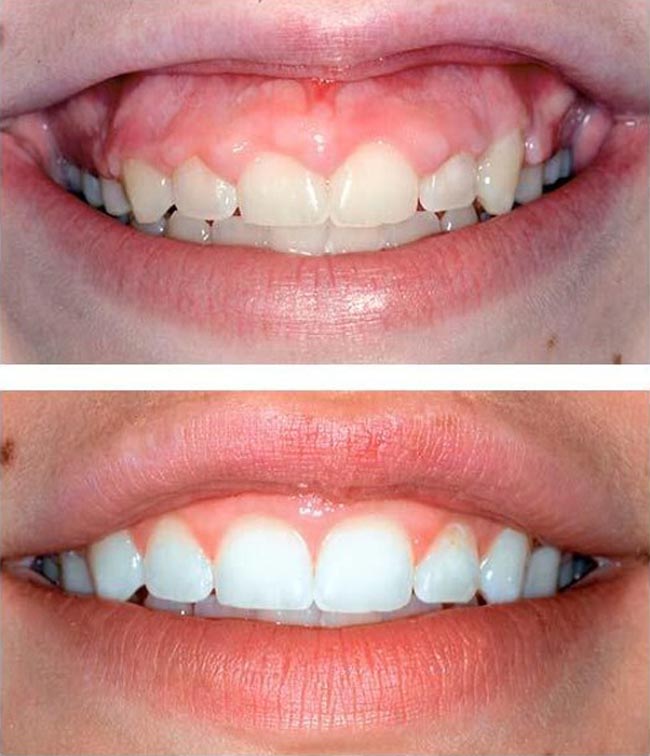
‘Gum lift’ is a patient-friendly term for procedures that alter the gingival margin. Depending on the clinical situation, this may involve gingival recontouring or gingivectomy, or surgical crown lengthening involving both soft tissue and supporting bone. These procedures are not interchangeable, and the treating clinician or periodontist must determine which approach is appropriate. Smile Art Lab works directly with dental professionals to make this a reality.
Key Takeaways
- Gum lifts must be planned within the DSD workflow before any fabrication begins.
- 3D digital planning helps align the proposed gingival contours with tooth proportions and facial references.
- Smile Art Lab works exclusively with dentists, never directly with patients.
- A validated 3D wax-up can help reduce remakes and chairside adjustments.
- Where periodontal treatment is required, it should be completed and allowed to heal before the definitive restoration margins and final design are confirmed.
What Is a Gum Lift and Why Does It Matter in Aesthetic Cases?
In the context of Digital Smile Design, the gum lift is not an afterthought. It is a foundational step. The position of the gingival margin directly affects tooth proportion, the appearance of the smile line, and the long-term fit of any ceramic restoration placed at or near the gingival margin.
The periodontal-restorative relationship is important when planning aesthetic and restorative cases. The proposed gingival position must be assessed against the underlying bone, soft-tissue dimensions and restorative requirements before the treating clinician determines the appropriate procedure.
How 3D Planning Changes the Gum Lift Process
Traditionally, gingival contouring decisions were made chairside, relying heavily on clinical intuition and two-dimensional photography. The introduction of 3D digital planning has fundamentally changed what is achievable and what is measurable.
At Smile Art Lab, the digital workflow begins when the dentist provides high-quality intraoral scans, standardised extraoral photography, and, where applicable, video of lip dynamics. These records are used to create a 2D/3D Digital Smile Design plan that proposes the gingival contours, tooth proportions and restorative objectives for clinical evaluation. Within that model, gingival contours are mapped alongside tooth proportions, midline position, and facial reference points before any physical fabrication takes place.
Within the 3D design phase, the laboratory can:
- The gingival zenith is the most apical point of the gingival margin, considered in relation to the tooth axis.
- The relationship between the smile line and gingival margins helps assess whether the gum display is appropriate for the patient’s facial proportions.
- Design the ideal post-treatment tooth form before the periodontal procedure begins, providing the dentist with a clear surgical target.
The Sequence: Why Gum Lifts Must Come Before Final Restorations
If definitive restorations are fabricated before the gingival position has been treated and allowed to stabilise, the margins and proportions may no longer correspond with the healed tissue.
The correct clinical sequence is:
- Complete digital records are submitted to Smile Art Lab.
- The proposed tooth shapes and aesthetic gingival positions are incorporated into the Digital Smile Design.
- A model and mock-up guide are produced so the proposed design can be transferred and assessed intraorally.
- The treating clinician evaluates the design, underlying bone, soft-tissue dimensions and periodontal requirements.
- The appropriate periodontal procedure is completed where required.
- Following adequate healing, the final preparation, tissue and occlusal records are taken.
- The definitive restorations are finalised using the healed tissue position.
How Gingival Contours Affect Ceramic Restoration Design
The gingival margin influences perceived tooth length, gingival symmetry, emergence profile and restorative margin planning. These factors should be evaluated together during the Digital Smile Design process.
Within the 3D design environment, gingival contours are mapped in relation to:
- The gingival zenith of each tooth is the most apical point of the gingival margin. and its position relative to the tooth axis.
- The interdental papillae, which must be preserved and accounted for in both the periodontal plan and the interproximal restoration design.
- The smile line ensures that the gum display during a natural smile is aesthetically appropriate for the patient’s facial proportions.
- Supracrestal tissue attachment requirements, which must be respected to prevent post-operative recession or inflammation around restoration margins.
The Role of the Dental Laboratory in Supporting Gum Lift Cases
The specific laboratory outputs that support gum lift planning include:
- 3D Ideal Post-Treatment Design: Produced before any clinical procedure, this shows the proposed tooth shapes and gingival positions for the clinician’s assessment.
- 3D Model and Mock-Up Guide: A 3D-printed model or mock-up guide allows the proposed design to be transferred and evaluated intraorally before treatment begins.
- Digital Planning Outputs: The approved smile design establishes the planned gingival contours, allowing the treating dentist to coordinate periodontal treatment before final ceramic fabrication.
This laboratory-led planning approach reflects broader developments in digital dentistry, where digital smile design and its role in communication between dentist and laboratory was a central theme for the profession. Smile Art Lab supports multidisciplinary digital smile design workflows from planning through final ceramic design.
Conclusion
Gum lifts are not a peripheral step in Digital Smile Design. They are a precision clinical procedure that, when planned within a 3D digital workflow, supports a more predictable restorative outcome. If you are managing complex aesthetic cases and want laboratory support that begins at the planning stage, contact us today to discuss laboratory support for your next digital smile design case.
FAQs:
What is a gum lift in Digital Smile Design?
A gum lift reshapes the gingival margin to create the proportional tissue position required before ceramic restorations are designed and fabricated.
Does Smile Art Lab work directly with patients on gum lift cases?
No. Smile Art Lab works exclusively with dental professionals, providing 3D digital planning and laboratory fabrication to support the clinician throughout the Digital Smile Design workflow.
When in the DSD workflow should a gum lift be performed?
After the 3D design and intraoral mock-up have been evaluated, but before the definitive restoration margins and final design are confirmed.
Why is 3D planning important for gum lift cases?
It maps gingival contours against tooth proportions and facial landmarks, ensuring the periodontal procedure achieves a precise and aesthetically planned outcome.
Can restorations be planned before a gum lift is completed?
Yes. The proposed restoration and gingival position can be planned digitally before treatment. However, the final margins and definitive restoration should be confirmed using records taken after the periodontal procedure has healed.
What records does a dentist need to provide for a gum lift DSD case?
Intraoral scans, standardised extraoral photographs, a full-face image, and ideally a dynamic video of lip movement and smile function.