
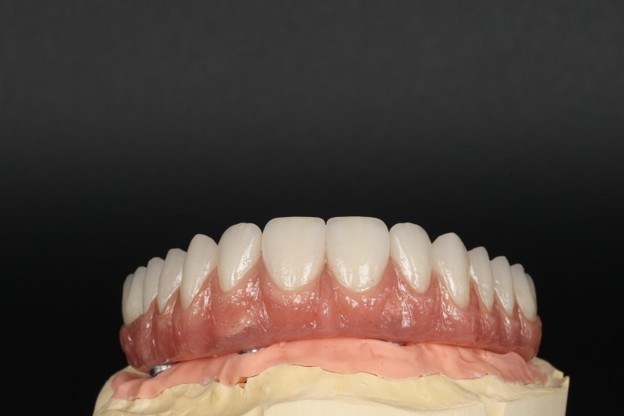
The prosthetic material and framework construction selected for an All-on-X case influence load distribution, long-term durability, aesthetics and maintenance requirements. Passive fit depends on the accuracy of the implant-position records, design, manufacturing and verification process. Smile Art Lab collaborates with dentists at exactly this stage.
Key Takeaways
- Material and framework selection should be considered during treatment planning.
- Passive fit depends on accurate implant-position records, design, manufacturing and verification, not on the framework material alone.
- Smile Art Lab uses Rodin Titan for immediate All-on-X temporaries.
- Definitive options include a titanium frame with zirconia sleeves, an ICE Plus zirconia framework, and a titanium bar with an acrylic wrap-around.
- Material selection should consider restorative space, occlusal load, implant distribution, aesthetics, hygiene access and repairability.
Why Framework Material Matters More Than Most Dentists Realise
In All-on-X treatment, innovative dental implants rely on more than just precise implant placement. The framework is not just a structural base. It is the element that determines how occlusal forces are distributed across the implants, how closely the prosthesis fits the abutments, and how the overlying aesthetic layer performs over time.
A framework that does not fit accurately can increase strain on the prosthetic components and contribute to technical complications such as screw loosening or component fatigue. Choosing the right material and fabrication method from the outset helps minimise long-term technical complications.
Technical complications, including chipping, fracture, and adhesive failure, are closely linked to both the framework material chosen and the quality of its fabrication.
Rodin Titan: Our Material for the Immediate Temporary
Smile Art Lab uses Rodin Titan for immediate All-on-X temporaries. It is a ceramic nanohybrid printing resin designed for full-arch restorations and provisional hybrid dentures.
The approved pre-surgical design is converted into the immediate restoration on the day of surgery using the captured implant positions. After printing, the restoration is cured in the Otoflash under nitrogen and finished with pink composite where required.
The immediate restoration allows the clinical and laboratory teams to assess aesthetics, phonetics, occlusion, hygiene access and soft-tissue adaptation before the definitive prosthesis is completed.
Titanium-Based Definitive Options
Titanium provides a strong and rigid foundation for full-arch implant prostheses. Smile Art Lab offers two principal titanium-based constructions:
- A titanium frame with individual zirconia sleeves.
- A titanium bar with an acrylic wrap-around.
For acrylic wrap-around restorations, our preferred combination is Candulor composite teeth with high-impact acrylic. This construction also provides practical options for maintenance and repair. Alternative materials such as G-CAM or Zantex can be used where requested and appropriate for the case.
ICE Plus Zirconia Framework
ICE Plus is a high-strength zirconia from Zirkonzahn that can be used to produce a reduced zirconia framework. According to Zirkonzahn, ICE Plus has a flexural strength of approximately 1,650 MPa without HIP and 1,900 MPa with HIP.
This provides Smile Art Lab with a strong metal-free framework option for selected definitive All-on-X cases. The final material and construction are selected according to restorative space, implant distribution, occlusal demands and the aesthetic requirements of the case.
How Smile Art Lab Approaches Framework Material Selection With Dentists
The laboratory’s role is to provide the clinical team with the technical information needed to make a confident, evidence-based material choice.
The information that informs framework material selection includes:
- Available Interocclusal Space: Available restorative space influences the dimensions and construction of the prosthesis. The laboratory must assess the space available for the framework, teeth, gingival material and prosthetic connections before recommending a construction.
- Occlusal Load and Bruxism Risk: Patients with a history of heavy occlusion or parafunction require careful material consideration and discussion of long-term maintenance.
- Aesthetic Priorities: Aesthetic requirements should be considered together with restorative space, framework design, implant distribution and long-term maintenance.
- Case Span and Implant Distribution: Anteroposterior spread and connector dimensions determine which material can be safely specified for the planned prosthesis geometry.
How 3D Planning Shapes the Material Decision
At Smile Art Lab, we use advanced 3D digital workflows to assess each case before fabrication begins. This includes reviewing scan data, occlusal analysis, and implant positioning to determine which material will perform best for that specific patient.
The 3D planning stage helps us identify:
- Whether cantilever extensions are required
- The degree of occlusal load the framework will carry
- The aesthetic zone requirements and tooth shade targets
- Which definitive construction is most appropriate: a titanium frame with zirconia sleeves, an ICE Plus zirconia framework, or a titanium bar with an acrylic wrap-around.
3D planning allows the clinical and laboratory teams to evaluate restorative space, implant distribution, cantilever requirements and prosthetic design before fabrication begins.
Material Longevity: What the Evidence Says
Long-term performance depends on several clinical and technical factors, not simply the framework material.
Key factors that affect framework longevity include:
- The number and distribution of implants
- Parafunctional habits such as grinding or clenching
- Framework design, particularly connector cross-section dimensions
- Passive fit accuracy, which reduces stress at the implant-abutment interface
Passive fit remains one of the most critical parameters in preventing long-term framework complications, regardless of the material used.
Conclusion
Framework material selection is one of the most consequential decisions in any All-on-X case. Titanium, zirconia, or a combined design each has a specific clinical role, and none should be chosen without a full assessment of the patient’s functional demands, aesthetic goals, and prosthesis geometry. Contact us today to discuss your next case.
FAQs:
What is the best framework material for All-on-X prosthetics?
Restorative space, implant distribution, occlusal demands, aesthetic goals, hygiene access and maintenance requirements all contribute to the framework and prosthetic construction decision.
What material does Smile Art Lab use for an immediate All-on-X temporary?
Smile Art Lab uses Rodin Titan, cured in the Otoflash under nitrogen and finished with pink composite where required.
How do I know which material is right for my patient?
Discuss the case with your dental laboratory before finalising the design. Factors like bone quality, bite force, and aesthetic goals all inform the right choice.
How does CAD/CAM milling affect framework passive fit?
CAD/CAM milling from accurate 3D digital data consistently produces frameworks with superior passive fit compared to conventional casting methods.
What definitive All-on-X constructions does Smile Art Lab offer?
Smile Art Lab offers a titanium frame with zirconia translucent, an ICE Plus zirconia framework with zirconia translucent, and a titanium bar with an acrylic wrap-around.
What records does a dentist need to send for All-on-X framework fabrication?
For definitive fabrication, the laboratory generally requires an accurate implant-position record, a soft-tissue scan, an approved tooth setup or provisional design, verified occlusal records, clinical photographs and the relevant implant component information. CBCT data is primarily used during implant surgery planning.