
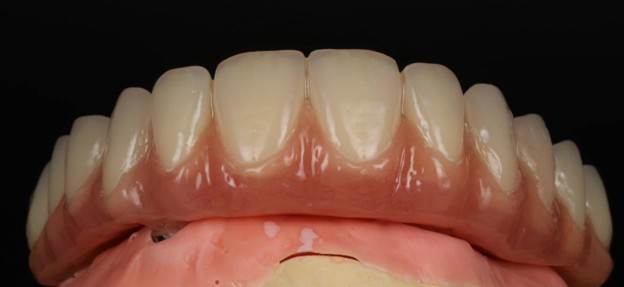
All-on-X is not a solo endeavour. The clinical team that performs the surgery and the laboratory that fabricates the prosthetics must operate as a coordinated unit from the moment planning begins. When that collaboration is absent or poorly structured, the risk of complications rises sharply. Smile Art Lab is built around exactly this kind of partnership.
Key Takeaways
- Lab involvement must begin at the 3D planning stage, not at fabrication.
- Smile Art Lab provides Digital Smile Design planning and laboratory support for dental professionals.
- The laboratory’s 3D design documents guide every stage from surgery through to final restorative planning.
- Clear digital communication reduces ambiguity and helps the clinical and laboratory teams identify missing or incomplete records early.
- Standardised digital records can help reduce avoidable prosthetic complications.
The Problem With Late Laboratory Involvement
In many dental practices, the laboratory is engaged late in the treatment process. The clinical team completes the surgical assessment, places the implants, and then contacts the laboratory to begin prosthetic fabrication. For an All-on-X case, involving the laboratory only after implant placement can create significant prosthetic challenges. Early collaboration allows the prosthetic design to inform the surgical plan before treatment begins.
Full-arch implant-supported rehabilitation is prosthetically driven. The position of every implant depends on where the final prosthesis needs to sit. If the laboratory is not involved in establishing the prosthetic target before surgery, the surgical team is effectively working without a confirmed destination. The result is often a prosthetic outcome that requires extensive chairside adjustment, or in more serious cases, remakes.
Digital workflow tools facilitate seamless communication among surgeons, restorative dentists, and dental laboratories, reducing uncertainty and enhancing outcomes. The research makes clear that this communication loop is not a supplementary feature. It is a foundational requirement for predictable full-arch outcomes.
What Early Lab Collaboration Actually Looks Like
At Smile Art Lab, our involvement in an All-on-X case begins when the dentist submits the required clinical records, including CBCT data where appropriate, intraoral scans, clinical photographs, and occlusal records. We work exclusively with dental professionals, providing 2D/3D Digital Smile Design planning to support a predictable restorative workflow. As a laboratory partner, our role is to develop and refine the treatment plan before definitive restorations are designed.
Early laboratory engagement in a structured All-on-X case includes:
- Implant Surgery and Prosthetic Planning: Smile Art Lab reviews the CBCT, intraoral scans, photographs and occlusal records to develop the proposed implant and prosthetic plan for the treating clinician’s review and approval.
- Pre-Surgical Design Approval: The proposed mock-up design is usually sent to the dentist for approval approximately five days before surgery.
- Implant-Position Capture: On the day of surgery, implant positions can be captured using the dentist’s preferred photogrammetry workflow. Smile Art Lab commonly works with True Abutment, Tupel and Aoralscan Elite.
- Immediate Conversion: The approved pre-surgical design is converted into the immediate All-on-X temporary using the captured implant positions.
- Material and Finishing: The immediate temporary is printed in Rodin Titan, cured in the Otoflash under nitrogen, and finished with pink composite where required.
Why Digital Communication Is Not Optional
The quality of communication between the dental clinic and the laboratory is one of the most controllable factors in a full-arch case. Inaccurate or incomplete records can contribute to complications, delays and remakes. In the analogue era, this risk was managed through multiple impression remakes and extended adjustment appointments. In a 3D digital workflow, it is managed through standardised data capture from the outset.
A 2025 review in the Australian Dental Journal found that digital workflows can provide significant advantages in treatment planning, communication, prosthesis design and fabrication. However, the authors also noted that no universally applicable digital workflow has yet been established.
Standardised digital records that enable accurate laboratory planning include:
- 3D CBCT Scan: Provides bone volume data, anatomical boundaries, and the spatial reference for implant position planning.
- Intraoral Digital Scan: Captures existing tooth structure, edentulous ridge contours, and occlusal relationship in three dimensions.
- Standardised Clinical Photography: Full-face, smile, and retracted views taken to an agreed protocol, allowing the laboratory to map tooth position, midline, and smile line accurately.
- Occlusal Records: Bite registration in maximum intercuspation and any relevant dynamic functional records.
How the Lab Supports the Dentist Through Every Stage of the Case
All-on-X cases unfold across multiple clinical stages over a period of months. The laboratory’s role does not end with the delivery of the immediate provisional. It continues through the healing phase and into the definitive restoration stage.
Here is how Smile Art Lab supports the clinical team across the full treatment timeline:
- Pre-Surgical Phase: 3D design of the planned prosthesis, diagnostic model fabrication, and restorative design.
- Surgical Phase: Restorative planning of the approved provisional bridge for immediate loading where the clinical criteria are met.
- Osseointegration Phase: The provisional bridge is adjusted at the clinic based on soft tissue healing and occlusal refinement. Any design changes are communicated to the laboratory digitally.
- Definitive Fabrication Phase: After the healing period, updated intraoral scans and occlusal records are submitted. The laboratory workflow from the confirmed clinical data ensures that the final prosthesis is a precise extension of the validated provisional outcome.
Photogrammetry can provide an accurate digital record of implant positions in complete-arch cases. Smile Art Lab can work with the clinician’s preferred system, including True Abutment, Tupel and Aoralscan Elite. The implant-position data is combined with the approved pre-surgical design to produce the immediate restoration.
The Cost of Poor Lab Collaboration in All-on-X Cases
When lab collaboration is reactive rather than proactive, the costs manifest in several ways:
- Extended chairside adjustment time when a prosthesis produced without adequate pre-surgical design validation requires significant modification to achieve acceptable fit and aesthetics.
- Remakes, where the dimensional discrepancy between the implant positions and the fabricated prosthesis is too large to correct at the chair.
- Compromised fit, which can increase strain on the prosthetic components and contribute to technical complications such as screw loosening or component fatigue.
- Patient dissatisfaction, which typically relates to prolonged treatment timelines and aesthetic outcomes that differ from expectations set during the consultation.
Understanding the differences between open and closed digital systems and appreciating the need to design a structured digital workflow are now core competencies for Australian dental professionals. The laboratory is an integral part of that workflow, not a downstream service provider.
What to Look for in a Lab Partner for All-on-X Cases
Not every laboratory is equipped to handle the demands of full-arch implant rehabilitation. When evaluating a potential lab partner for All-on-X cases, dentists should look beyond turnaround times and pricing.
The questions worth asking include:
- Does the lab review records and provide feedback before starting treatment planning?
- Is the lab able to contribute to 3D planning discussions?
- What is the lab’s process for managing cases that require refinement?
Conclusion
Dentists who involve their laboratory during planning and maintain clear communication throughout treatment can reduce avoidable complications and achieve a more predictable restorative workflow. Smile Art Lab supports dentists through a structured digital workflow, from implant surgery and prosthetic planning through design approval, immediate Rodin Titan conversion and definitive restoration. Contact us today if you are ready to work with a laboratory built around this standard.
FAQs:
When should a dental laboratory be involved in an All-on-X case?
At the planning stage, before surgery. The lab must design the prosthesis first so implant placement supports the planned prosthetic outcome.
What should dentists look for in a lab partner for All-on-X cases?
Clinical engagement, 3D planning capability, clear communication protocols, and experience with full-arch implant rehabilitation are essential.
What happens if laboratory communication is poor in an All-on-X case?
Passive fit problems, extended chairside adjustment, prosthetic remakes, and long-term biomechanical complications at the implant interface can all result.
What digital records are needed for lab collaboration on All-on-X cases?
A 3D CBCT scan, intraoral digital scan, standardised clinical photographs, and occlusal records are the core records required for accurate 3D prosthetic planning.
How does the laboratory contribute to All-on-X surgical planning?
The lab designs the 3D prosthetic target that drives implant positioning, and can also collaborate on surgical guide fabrication using the merged digital data.
When are definitive restorations designed?
The definitive restoration can be planned during the earlier design stages, but its final design and fabrication are confirmed after healing and once updated clinical records have been received.